July is a time for sunshine, swimsuits and serious sweat sessions. It’s also a time to make sure we all stay cool, covered and safe. That’s why MISSION Instant Cooling Gear and their proathlete founders are dedicated to spreading the importance of National Heat Safety Month this July.
Co-founder Chris Valletta, former NFL player, experienced heat related illness during his college and professional football playing days — so this initiative is personal for him.
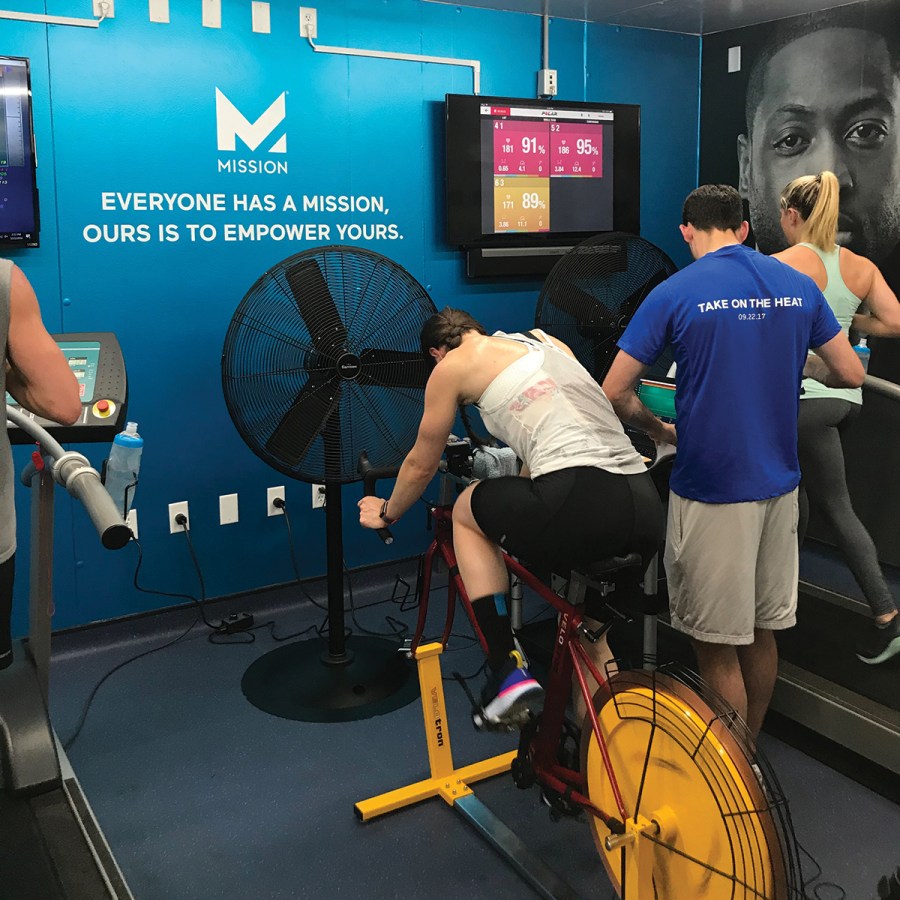
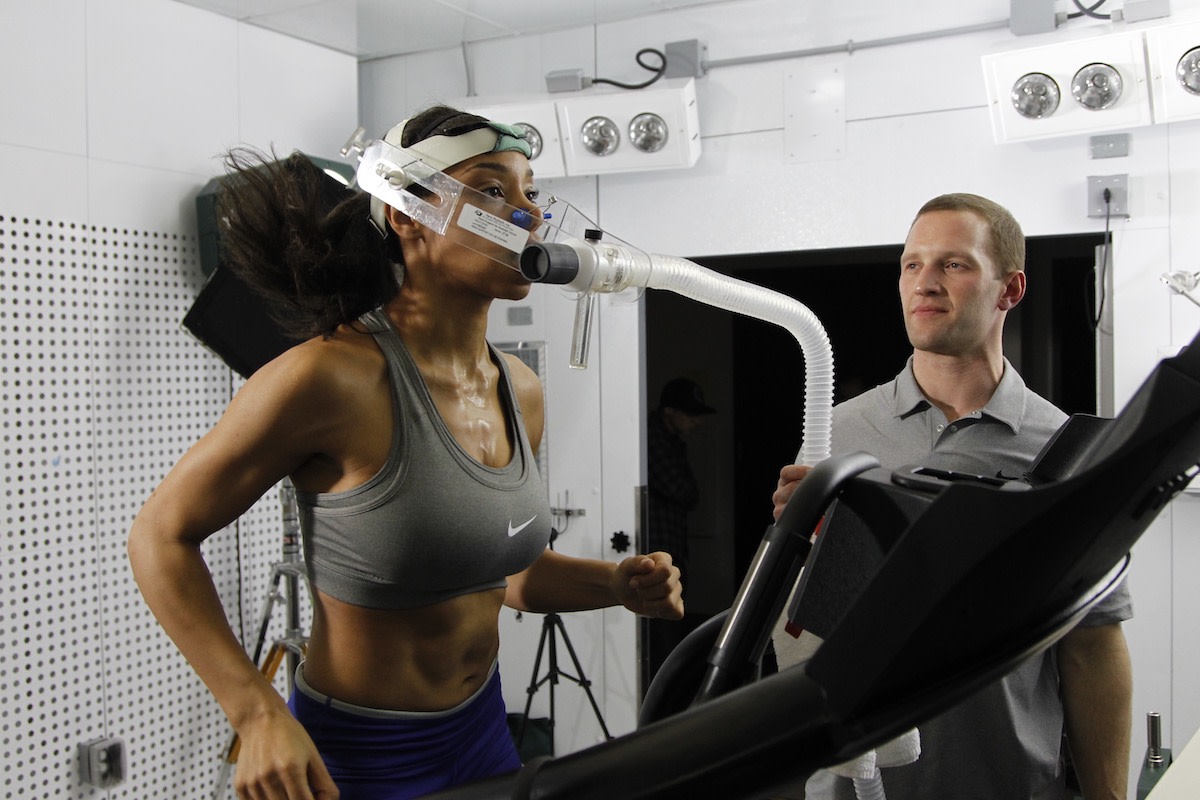
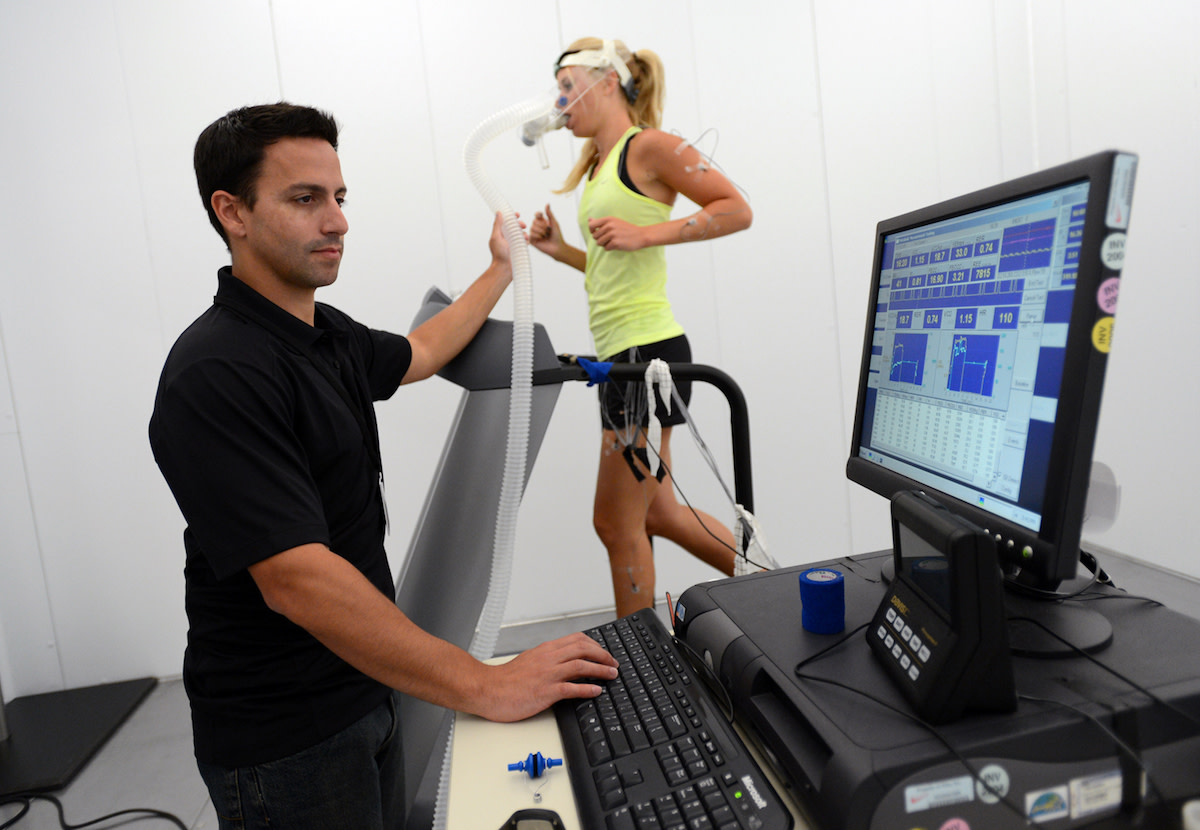
Mission is so passionate about Heat Safety they invested in The Mission Heat Safety Lab at UConn’s Korey Stringer Institute. Mission products have been tested on athletes with state-of-the-art equipment like high speed treadmills, advanced bike ergometers and a comprehensive physiological monitoring system — so you know these items are legit!
“Mission and the Heat Safety Coalition has the ultimate goal of improving heat safety in the consumer and industrial settings. These cooling products are a vehicle to get there.” —Dr. Casa, CEO, Korey Stringer Institute, Professor, Department of Kinesiology, Director, Athletic Training Education.
SAFETY TIPS FOR SUMMER WORKOUTS
Here are some tips to stay fit, cool and most importantly safe this summer with Mission Cooling Gear.
TIP 1# RUNNER’S PARADISE
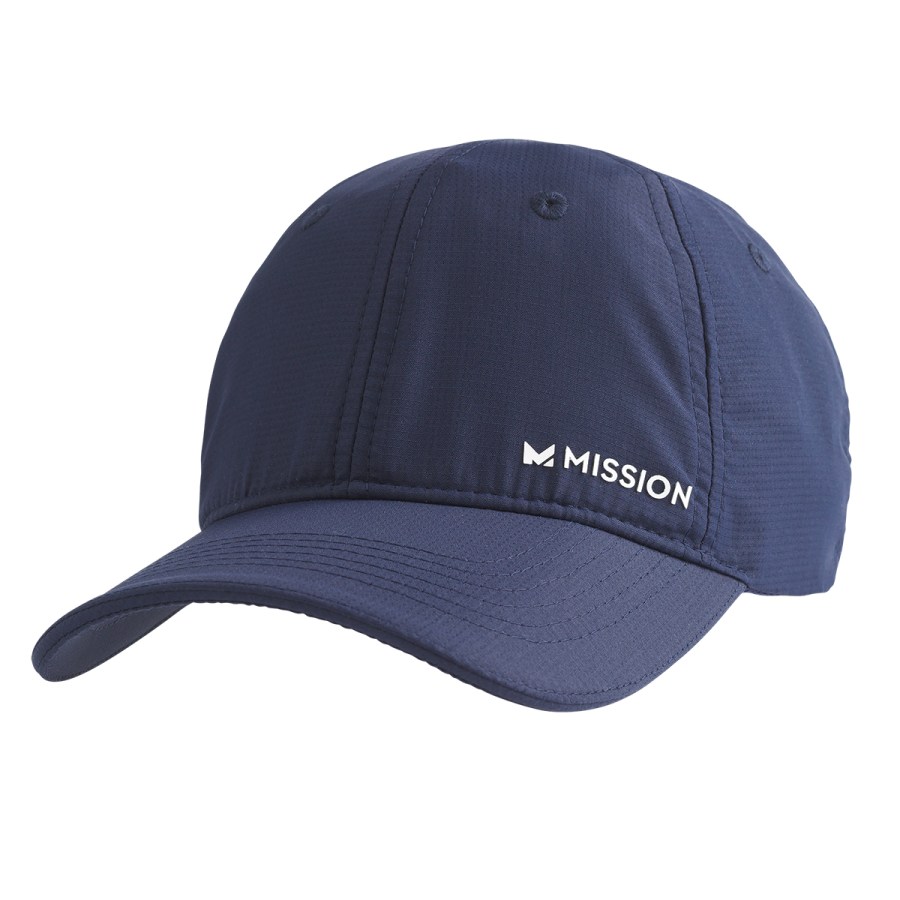
Don’t forget to wear a MISSION Cooling Performance Hat to block the sun and try to avoid running outside between 10 AM and 4 PM when the sun is strongest.
TIP #2 BACKYARD FAMILY BOOTCAMP
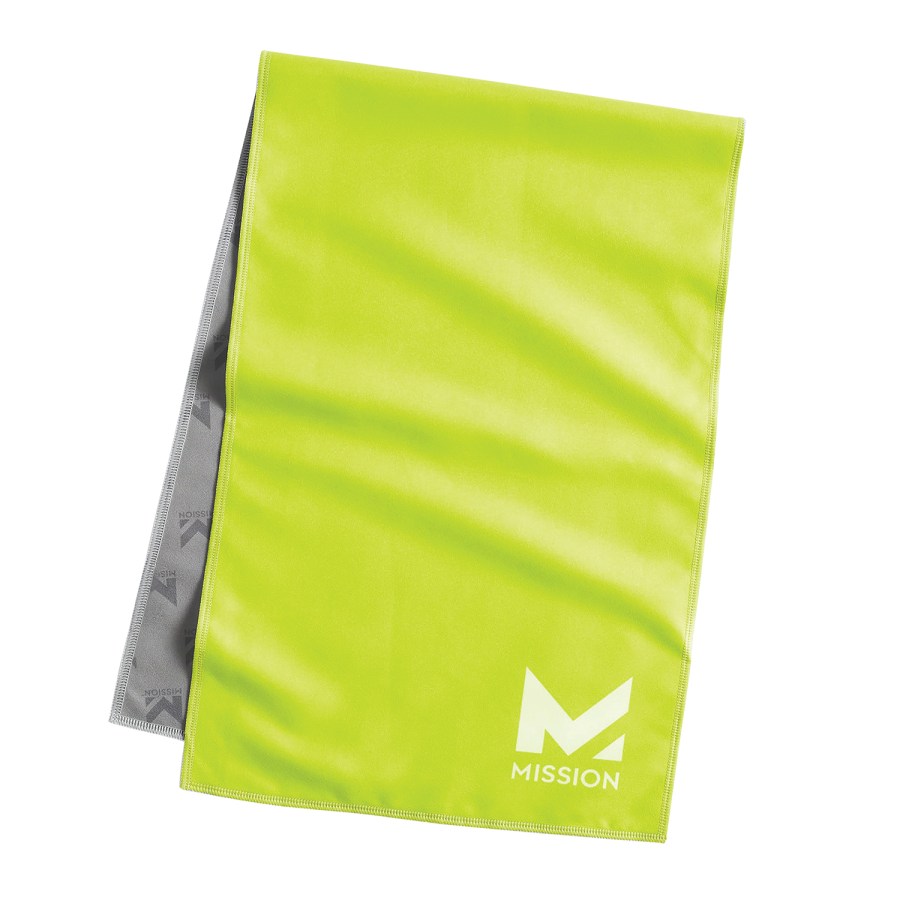
Look for a shaded area where you can all get a little family fitness in! Make sure to arm the entire family with MISSION Cooling Towels. Their brushed microfiber cools instantly.
TIP #3 DOG DAYS OF SUMMER
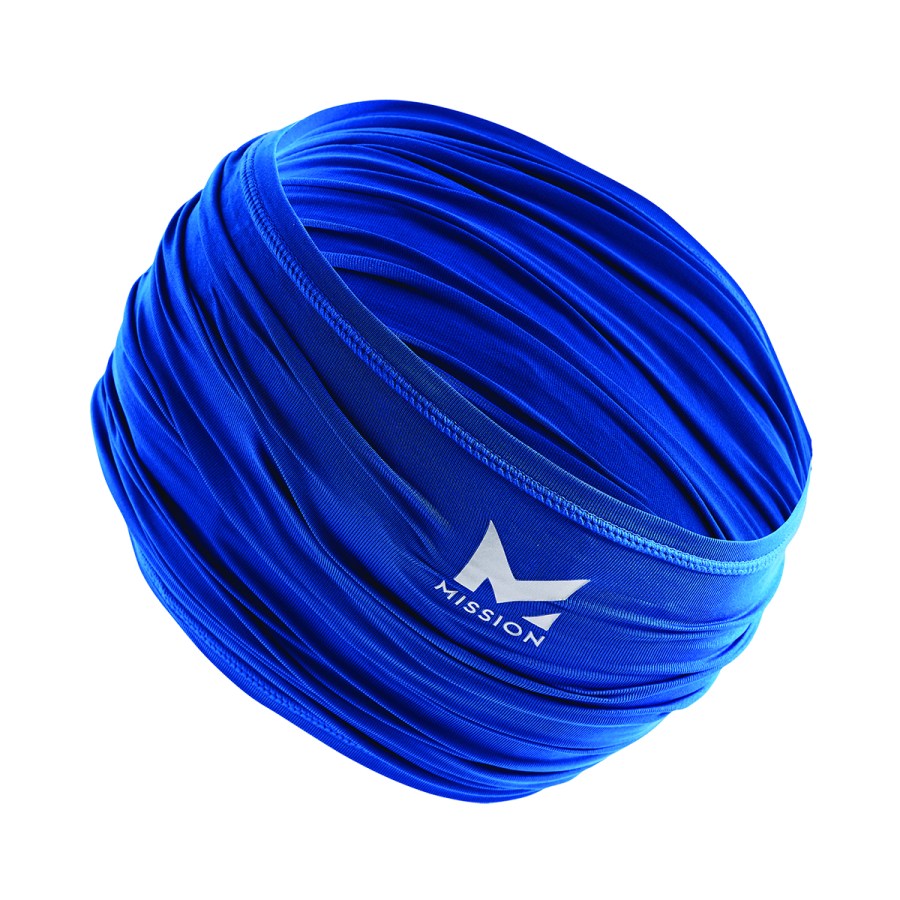
Even moderate workouts like taking your furry BFF Gaiter to stay safe for a stroll are more intense during the summer months. Rock this MISSION Gaiter to stay safe and cool. And don’t forget water for you and your pet.
Mission Cooling Gear available at Walmart, The Home Depot, Target, CVS and Mission.com
On the muggiest, swampiest days of summer, you’ve no doubt questioned if running shirtless is the best way to beat the heat. But before you start thinking about how to kit up or strip down, you should understand what happens to your body in the heat.
“When you exercise, you use energy that’s stored in your body to perform the work,” explains Samuel N. Cheuvront, Ph.D., a research physiologist who studies fluid balance and endurance exercise. “But only about 20 percent of all the energy we’re generating when we exercise actually goes toward performing the physical work; the rest of it is turned into heat.”
Your body has a limited capacity for storing that heat energy. So when your brain senses your body temperature has increased, it elicits two responses: It shunts more blood flow to the skin, where increased vasodilation—a widening of the blood vessels at the skin’s surface—prepares your body to start dumping heat, explains Chris Minson, a professor of human physiology at the University of Oregon, who studies heat acclimation responses in athletes. At the same time, your brain signals the millions of sweat glands in your body to push water vapor through your pores onto your skin, where it then evaporates. It takes energy for that liquid to shift to gas; that’s how your body gets rid of excess heat, he explains.
That process of evaporation is crucial. If you wipe sweat off or it just drips off of you, it’s not taking any heat with it. As any runner knows, it’s not necessarily the heat that makes summer running feel so hard, it’s the humidity. The more humid it is, the more water vapor is in the air, says Cheuvront. And “when the water vapor pressure of the air is greater than the water vapor pressure of your sweat, your sweat won’t be able to evaporate—it just drips,” he explains. And so all that heat you’re generating is just building up in your body with no release.
On those hot, humid runs, “the less clothing you wear, the more opportunity there is for an evaporative heat exchange between your skin and the air,” says Cheuvront. (If it’s super swampy, though, you won’t be able to balance heat production with heat loss—even if you’re running naked. In that case, you can either lessen your intensity to produce less heat, or you can seek out active cooling like running through sprinklers.)
A nice breeze and/or the natural airflow you’re generating while cruising along—called convection—can facilitate the efficiency of evaporation, even in humid conditions. “When there’s a breeze across your skin, it pushes that more humid air away from you so the air near your skin is drier,” says Minson.
Opting for more skin exposure is generally the best choice if it’s not too sunny or you’re running in the shade. But if you’re running at noon on a cloudless day, adding a layer over your skin can be beneficial. “When there’s more direct sun, that solar radiation can heat you up a lot,” says Minson—even if the air temperature isn’t actually that high. In those conditions, you want to protect the skin not just from sunburn but from solar heat gain. Wearing light clothing (no dark colors!) can help reflect or block some of those heat waves, he adds.
If you’re self-conscious about running shirtless in public, that’s cool. While all clothing is insulative to some extent (trapping air and preventing evaporation), there have been so many advances in fabric technology that you can easily find a lightweight shirt that won’t drag you down. “You want to wear clothing that has very low insulation; we call it a low-CLO value,” says Cheuvront. “It should be highly permeable to absorb sweat easily and evaporate that sweat easily. The surface of the clothing will actually be cooled by the sweat evaporation and that in turn will keep the skin cool.” Look for words like quick-drying, sweat-wicking, and breathable.
Just remember that “when it comes down to it, there’s nothing that enhances our sweating ability better than our own skin,” says Minson. And it’s hard to feel shy about shedding your shirt when you feel the sweet relief that comes with all that fresh air on your skin.
If you do want to don clothing, try these light, breathable running essentials.
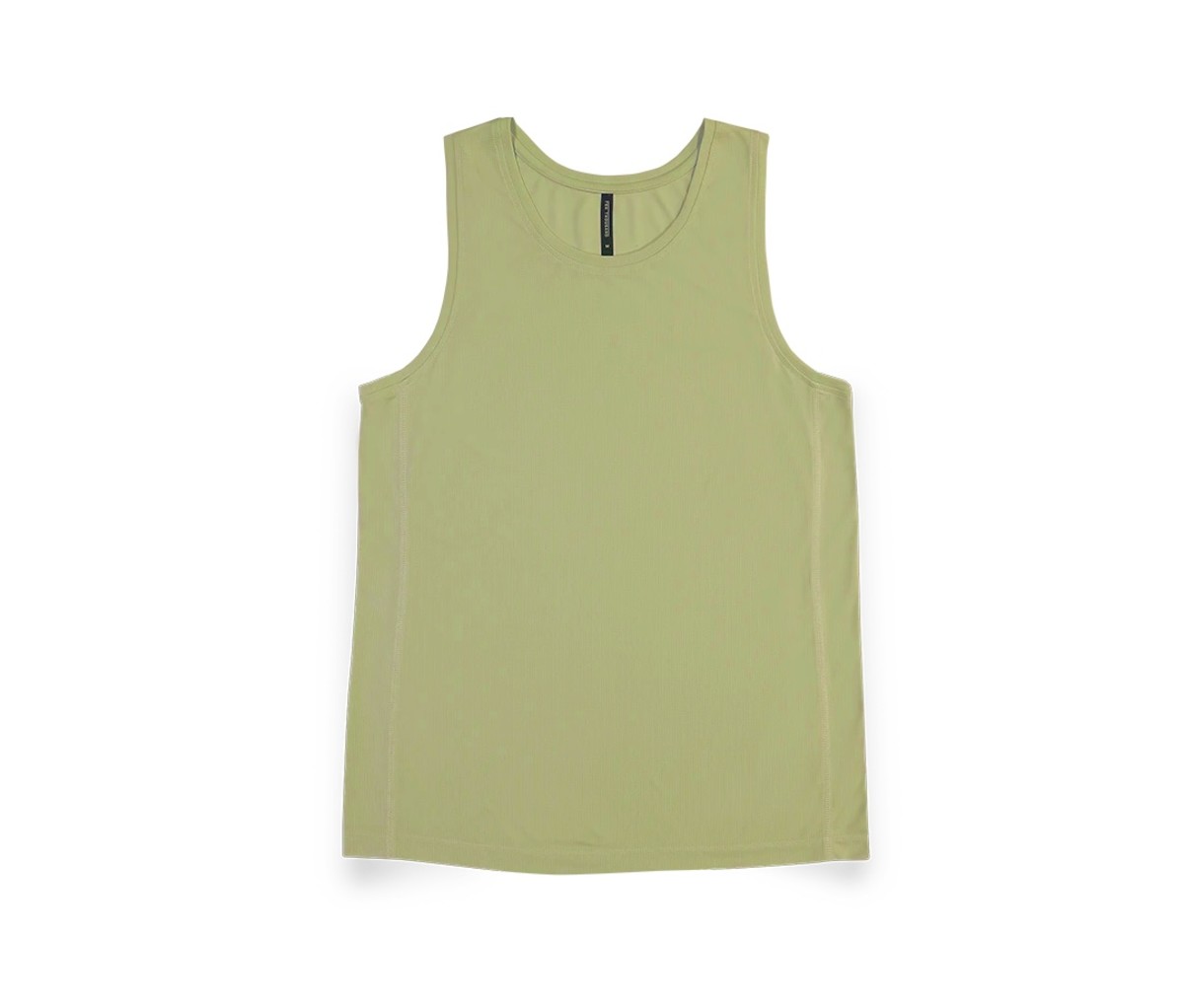
Ten Thousand Distance Tank Courtesy Image
Ten Thousand Distance Tank
Micro-eyelets create ventilation throughout the entirety of this tank. It minimizes cling, drapes over your body for minimal chafing, and is treated with silver ions to mitigate stink. Not a fan of tanks? Ten Thousand also makes a Distance Shirt ($54; tenthousand.cc) in the same material and sage green colorway.
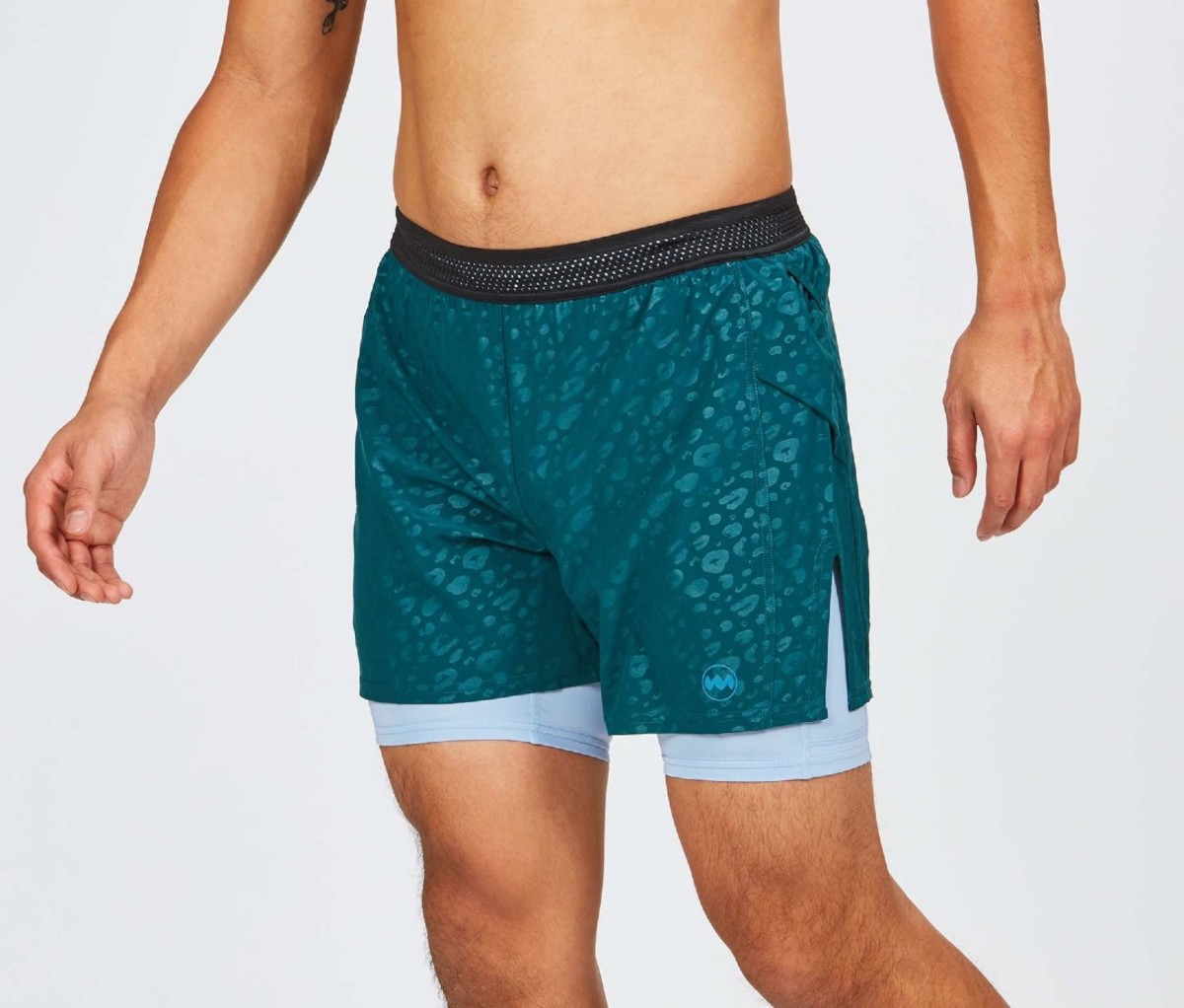
Janji Men’s 8″ 2-in-1 Traverse Short Courtesy Image
Janji Men’s 8″ 2-in-1 Traverse Short
You don’t need thigh-baring short-shorts to stay comfortable. Janji’s Traverse Short pairs a sweat-wicking brief liner with an 8″ inseam for modesty with a woven shell short. Two elastic pockets and a loop bungee offer plenty of solutions for storage (that loop can be used to keep keys secure or a shirt should you resort to running shirtless).
Neck gaiters are experiencing a surge in popularity due to the COVID-19 pandemic. They’re lighter, more breathable, and quicker to dry than bandanas and can be pulled up to cover your mouth and nose when passing pedestrians and other runners. (Pro tip: Wear a cap, then tuck the top of the gaiter into the back opening so it’ll actually stay up on its own.) Mission’s has a UPF 50 rating that blocks up to 98 percent of UV rays. If the weather is exceptionally hot, you can wet the gaiter, wring it out, then snap it to activate its cooling technology: In less than 30 seconds, it’ll cool down to 30 degrees below average body temperature. If you do this, just keep it around your neck (wetting will make it impossible to breathe through).
While every surfer has spun a tale or two about surf injuries—a board to the back of the head, a hand sliced on a fin, a dislocated joint after a particularly violent closeout—these injuries are actually rather rare.
There is a surf malady much more common, far less mentioned, and potentially considerably more dangerous: exostosis (aka surfer’s ear). It’s a problem that affects close to one out of every three surfers and, if untreated, can cause pain and severe hearing loss.
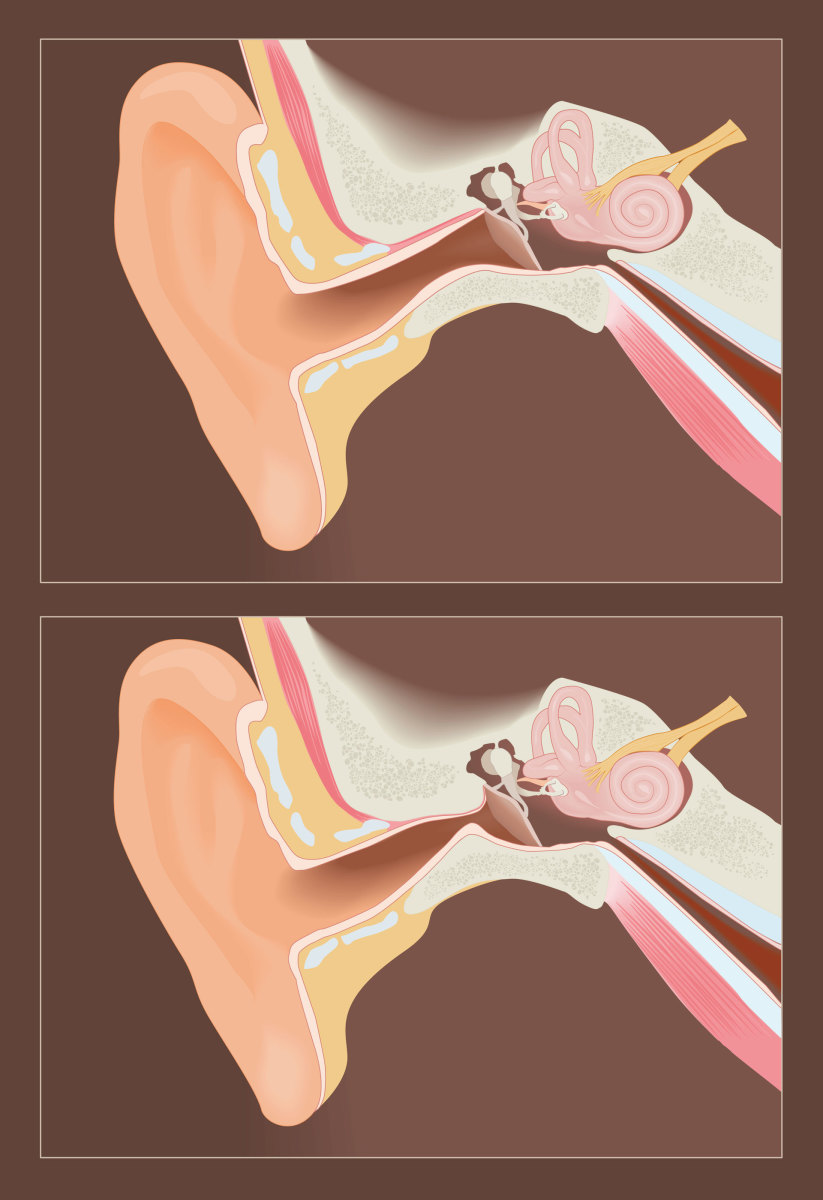
The condition is caused by prolonged exposure to cold water and affects both young and old surfers. When the ear canal is irritated over a long period of time, it responds by growing bone, effectively narrowing the canal and causing hearing loss.
Eventually, this bone growth becomes so pronounced that it can lead to total hearing loss and can be treated only by cutting out or shaving down the bony growth, a process that requires a six- to eight-week recovery.
A healthy ear (top) vs. surfer’s ear (bottom). Photo: struna/Shutterstock
“As we have developed very good wetsuits and surf year-round in colder and colder water, the irritation from the cold water is causing exostosis, or surfer’s ear,” says Dr. Ken Fujioka, a San Diego–based doctor and avid surfer who has undergone surfer’s ear surgeries on each ear. “I don’t know why we don’t hear about it more.”
In addition to leading to hearing loss, the growths also trap water and cause frequent infections, which can be particularly harmful for those spending extended periods in the surf. Now that wetsuits are extending seasons longer and longer, that risk is amplified, even for younger surfers.
Surgery is the only real “cure” for surfer’s ear, but Fujioka notes that prevention is likely the best form of treatment.
See those guys in the lineup sporting the earplugs? Many, if not all of them, are hoping to prevent surfer’s ear and some serious medical headaches.
For those who think earplugs impair hearing, a few companies, like SurfEars out of Sweden, have designed surf-specific plugs that let sound waves in while keeping the real waves out.
Fujioka is unsure why there is so little publicity surrounding the ear injury, given its prevalence in the surf community, but thinks that surfer’s ear will continue to grow as the sport becomes more popular around the world.
“I am amazed at the number of surfers that do not wear earplugs (my son included), and know surfer’s ear is no joke,” says Fujioka. “I have had the surgeries myself and I could not surf; it was no fun.”
Did you know that bands can help you build muscle and improve your PRs? Learn how bands can have you training harder and more efficiently than you ever thought possible!
from Bodybuilding.com Articles https://ift.tt/380dXqw
via IFTTT
Health and fitness personalities are often judged on their appearance, so losing skin pigmentation could be devastating. For three remarkable role models, it only made them stronger.
from Bodybuilding.com Articles https://ift.tt/3evNgfN
via IFTTT
Olympic marathoner Guor Mading Maker thought he was done running when he was granted asylum by the United States in 2001. No one would blame him. He spent most of his childhood running for his life.
Mading Maker grew up in South Sudan amidst a civil war, and was just 8 years old when his parents sent him away to find his uncle in hopes of escaping the violence. But shortly after, he was captured and enslaved by a group of Messiria, an ethnic group of herdsman in Western Sudan. He became one of Sudan’s “Lost Boys,” roughly 20,000 adolescents who were displaced during the war.
Following a daring escape, Mading Maker ran through northern Sudan, eventually landing in a refugee camp in Egypt. He was united with his aunt and uncle in Concord, New Hampshire, where he began attending high school. Soon after, during one of his PT classes, a teacher noticed his natural athleticism and asked him if he wanted to try track and field.
“I didn’t realize running was a sport,” Mading Maker tells Men’s Journal. “I had never seen it in that light before.” Following a little convincing, he signed up—a decision that would forever change his life, as seen in the newly released documentary Runner.
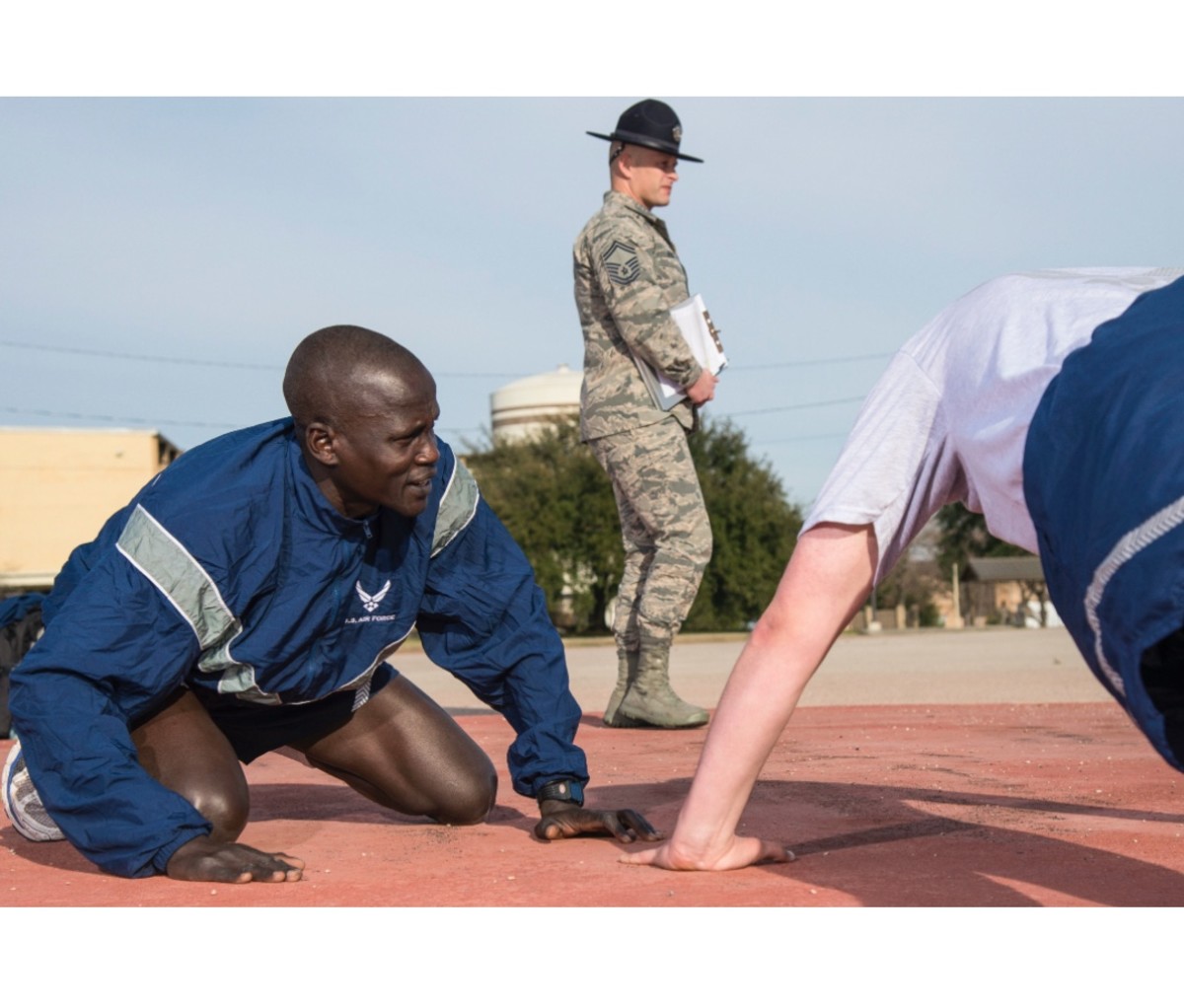
Now, Mading Maker is a two-time Olympian, training for his third Olympic Games, and a member of the United States Air Force World Class Athlete Program; he served at the Colorado Springs base as an Airman. Here, he reveals more about his tumultuous upbringing and how running has changed his life.
Men’s Journal: What are your earliest memories of growing up in South Sudan?
Guor Mading Maker: Back home, I was always a very active kid. I spent a lot of time helping my father with his goats and sheep, as well as other farming chores. In my country, every kid is like that, outdoors all of the time. Of course, growing up in a warzone, there was a lot of danger and violence, which was difficult to escape. It’s hard for me to think about those early years and that time in my life. I try to avoid those memories, because it brings me nothing but sadness. Yes, there were happy moments with friends, but it was more tragic than anything. I don’t consider my story special in this regard, though. There have been and still are many young people who are refugees. If you’ve been forced to flee from your own country, you’re going to have challenges, maybe each to a different scale, but in many ways the same.
What was the hardest adjustment when you came to America?
The most difficult part of acclimating was learning the language. Back in South Sudan, I was only speaking one language. I had to learn Arabic when I moved to northern Sudan and then Egypt. All these places also had different cultures I had to understand. Coming from African culture, the States were completely different. There was a lot to get used to from the food to the language to the culture. But I’m glad I found running, because the friends I made I will have for my whole life. It allowed me to connect with my peers. I look back on my decision to join the running club and say thank God because of the gifts and relationships that it’s given me.
I initially had no interest in running. I felt like I had run enough back in Sudan—and in that instance I had been forced to run to save my life. So when I arrived in the United States, I had no interest in running any longer. Even more, I had no idea that running was a sport. I had never seen anyone running on television and I had really never heard of it. The only sport I’d seen back home was soccer, which I saw on a television back in Egypt.
What were some of the initial challenges?
I couldn’t believe the distances they were running. I just thought it was crazy. Why would you run for that long? And how? I thought that maybe I would just do it to make friends, which I did, but when I eventually won a national indoors championship it became a lot more serious for me. I could see it being a way for me to be of use and help others. My coaches started telling me about the potential for scholarships, and the chance to get a proper education was very appealing.
Do you remember when you actually fell in love with running?
During my training in high school I started to become addicted to it. Every day that I didn’t run I felt like I was missing something. No matter what, I’ll get in at least a jog, even if it’s just six miles or so at an easy pace. I feel the energy it gives me in my blood and in my heart. There were a lot of trails to train on in New Hampshire, and I trained hard on those consistently. By the time winter came around, we were pretty much stuck on the roads, because of the snow. Sometimes it would be so cold that we would just stay inside, doing laps in the gym. Every weekend our coach would take us out for a nice, scenic run— through the hills for about 15 miles or more. There was a small park nearby the school where we would do our cross country workout… staying out there to do a bunch of 800-meter repeats. I looked forward to those. I believe running can be a great therapist to anyone who’s prepared to really commit to it. Even if you are without trauma, it’s healthy for your mind.
How did your relationship with running change in college at Iowa State?
There was a major increase in mileage and intensity. Iowa was cold in the winter, even colder than New Hampshire. So everything was inside, for about two hours, doing 200 to 300 miles of track. We wouldn’t even take holidays because we were so committed to being the best. For me, I felt a sense of responsibility to be as good as possible, because of the opportunity I had been given from the school.
I believe running can be a great therapist to anyone who’s prepared to really commit to it.
How much did competing in the Olympics mean to you?
I knew that if I made it to the Olympics, and accomplished any kind of finish, it would mean something special for the young kids from my country, as well as for other refugees like me. My career has always been for them. I want to give them hope, for them to see where I’ve been able to go and perhaps do the same or go even further. I want them to dream. I have hope that some kid who’s in a refugee camp or who’s displaced may see footage of me running and know that they can do it too.
What was it like training for your first Olympics?
I pushed myself to my limits. The human body is incredible under adversity—but I may have pushed too hard. One day, my teammates actually took me aside and told me, Guor, you’re going to go crazy if you keep working like this. They thought I was putting too much on myself, but there was no other way it could be. I had the opportunity, so I needed to do everything in my power to make the most of it. That was my responsibility. If I’m healthy enough to run, I have to get out there.
How did the decision to run independently in the 2012 Summer Olympics come about?
I remember sitting with my roommate during my freshman year of college and making the decision that I wanted to run for South Sudan. Back then, South Sudan and northern Sudan were one country, but I always carried the people of South Sudan in my heart. So when it was determined that South Sudan wouldn’t be able to participate in those games, and I wasn’t going to be able to represent my home country, I had to decide an alternative. I understand that not many are given the opportunity to compete at the Olympics, but the only flag I wanted to raise was South Sudan’s. So my sights almost immediately turned to 2016 when I would have that chance.
What was that experience like—getting to raise the South Sudan flag?
Raising our flag during those Olympics is a moment I’ll never, ever forget. Raising it for my family, for the young kids of my country, and the millions who died during the war. I wanted to raise that flag in tribute for them. It’s tough to put the feeling into words. The thought of it brings tears to my eyes. Because I look back at all of the people we lost—my own siblings. It hurts so deeply. I see in my heart and in my mind that one day a kid from South Sudan will win the Olympics, of that I’m sure. I will be able to look back at the part I played in laying the foundation for that, and that makes me proud.
Who were your role models in the sport?
I remember when I first started to watch running on television there were a few guys who truly inspired me. One of them was the U.S. sprinter Michael Johnson, another was Haile Gebrselassie from Ethiopia, and another was Paul Tergat from Kenya. I looked up to these guys a lot. Even to this day, they’re my heroes. I dreamed to finish a marathon like them. I ended up meeting Paul Target at the 2016 Olympics, and I was thrilled to take a picture with this guy. I believe we look quite a bit alike, too! I hope to meet Gebrselassie one day as well. The way they competed was amazing—not just the way that they run, but the commitment they brought and their determination. I have their books and read them often for motivation. I actually used Paul Tergat’s program to train for the 2012 Olympics. I was obsessed! Those are my guys.
Guor Mading Maker serving as an Airman in United States Air Force World Class Athlete Program at Colorado Springs base Courtesy of U.S. Air Force
What drove your decision to join the Air Force after the 2016 Olympics?
I wanted to join the Air Force to give back. Following the Olympics, I was filled with gratitude for what I was able to do for South Sudan, but I wanted to also show respect to the United States, which helped me have that opportunity. It was here that I was welcomed and allowed to become the person I am today. I also wanted to help show that refugees can be productive in the countries where they reside. I wanted to thank the country as a whole, and I could think of no better way to do that than to put on the military uniform and serve.
How do you feel about the Black Lives Matter movement as it pertains to the world of running?
I believe it’s the responsibility of every society right now to eliminate prejudice, based on race, sex, or any other discrimination. We’ve come far, but there’s still further to go. The color of our skin should not separate us or put us against each other. We bleed the same blood, breathe the same air, and eat the same food. Let’s focus on what unites us. The sport of running is doing its part; they work hard to bring us together. You can see unity in the spirit of the sport. I think the Olympic village shows us a better way, countries may be at war, but inside the Olympic Village, where all the athletes gather, it’s about camaraderie. We may not speak the same language, but we have a common purpose. The friends I’ve made at those competitions will last my lifetime. I have never felt discrimination inside the sport. The only moments I have felt profiled is outside—on the street, where people may not be able to see I am an Olympian, an athlete, or a member of the military. The first anyone is going to see is an African man. That’s why it’s important to know the law, and the rules, so you can protect yourself, just in case. The way I look at it, every civilization has issues. We are a complicated species. I believe people are beginning to understand that this is not good for our society. We can be better.
How’s training going for the Tokyo Olympics—now slated for 2021?
The training is going well. The focus is there, nothing has deviated, even during the pandemic. I had a lot of injuries since 2016, but that’s a part of being an athlete. But I will not allow them to stop me. I’m taking care of myself, and the rest will take care of itself. Because of the pandemic, we aren’t meeting in big groups. We have two or three people in our training crews. I enjoy training in Colorado. It’s much different from Flagstaff, Arizona, where I used to train. There are a lot of hills and dirt roads. It’s really good for training for 10K up to marathon level—filled with beautiful scenery.
How do you stay motivated to this day?
Every morning when I put on my shoes before my workout, I repeat to myself that this is what I have to do. This is my moment. I have spent every day since I left my family thinking that I have to be better today than I was yesterday. I believe that that idea has helped me get to where I am today—that and the desire to help the people of South Sudan. It’s a driving force in everything I do.
“Runner” is now available on demand here (a portion of the proceeds benefit the Refugee Assistance Alliance).
Standard bodyweight reps can serve you well…for a while. But if you're craving some lower reps, here's how to upgrade your home workout for greater strength and muscle!
from Bodybuilding.com Articles https://ift.tt/3fONTBb
via IFTTT
This intense shoulder routine shows how resistance bands can stimulate muscle growth, strengthen the joints, and transform boring workouts for lifters of all backgrounds.
from Bodybuilding.com Articles https://ift.tt/2AS4mpp
via IFTTT
Since May 20, all 50 states have started to ease COVID-19-related shutdown restrictions. The first wave of re-opening included gyms—big box franchises and boutique studios. Understandably, many people are itching to get back into their strength regimens—to throw some weight around that’s not an adjustable dumbbell. Beyond safety precautions you should take before running to your iron palace, there are other things to keep in mind to avoid injuries getting back in the gym.
If you’re conflicted by a desire to chase a sweat or feel the need to make up for lost time, pause, says Matthew Ibrahim, a strength coach, adjunct professor, and Ph.D. student in sport performance. To ensure you make gains and avoid injuries, you want to manage your training frequency, intensity, and volume. Here are Ibrahim’s top tips for a smooth transition back into regular exercise again.
How to Avoid Injuries Now That Gyms Are Re-Opening
1. Go Slow, Taper Gradually
Most people feel the pressure to transform their physiques overnight since they’ve been out of the gym for so long. Scratch that thought and instead work yourself back into shape through a gradual approach. Use the first month or two to really focus on pristine form and technique rather than going all-out on the weights and spending hours at the gym. Using controlled tempo work like eccentrics (slow lowering) and isometrics (pauses) will help you refine your technique as you get back into training again.
2. Start With the Basics
Stick to foundational movement patterns at first. Sure, they may be boring but they always breed results. Whether you’re training for general health, athletic performance, or lifting prowess, results are what you’re ultimately after. Sticking to the basic exercises means mastering the squat, hip hinge (deadlift), and upper body pressing and rowing (horizontal and vertical). Begin here and the rest will work itself out as you ease back into things.
A common mistake people make is trying to pick up where they left off. Get that out of your mind. You’ve likely been training with bodyweight, bands, or light dumbbells for the past few months, which means your overall intensity has been down. There’s nothing wrong with that at all. Just make sure to manage your expectations when you jump back into training in the gym. Start out lighter than normal and increase weight (intensity) slowly over the first couple of months. There’s no rush here either, so take your time.
4. Make Wellness Well-Rounded
The easiest boxes to check off with respect to your health are sleep quality, good nutrition, and adequate hydration. Essentially, these are the lowest hanging fruit in recovery. If you check these boxes off on a consistent basis, you’ll likely find it much easier to attain success in the gym and feel more refreshed in between workouts.
One of the easiest forms of physical activity that is often overlooked in training is going for a walk. Be sure to get outside for a walk each day if you can now that the nice weather is poking its head out for summer. Aside from getting quality vitamin D from the sun, you’ll also benefit from breathing in the fresh air, decompressing from the stress of the workday, and performing some low-level aerobic exercise. It’s not all about high-intensity training. You need some low-intensity forms of movement in your life, too.
Brad Pitt has been fit since he came on the scene in Hollywood, but there are a few of his movie physiques that are etched indefinitely in our brains. The first is Fight Club, in which he played the underground resistance leader Tyler Durden. The dirty, shirtless image of him standing over a bloodied opponent, celebratory cigarette hanging from his lips, has remained a physical pillar of masculinity for many a young man (even if it’s a bit stereotypical).
But there is a movie that rivals his Fight Club physique—the gritty Guy Ritchie drama he filmed right after, Snatch.
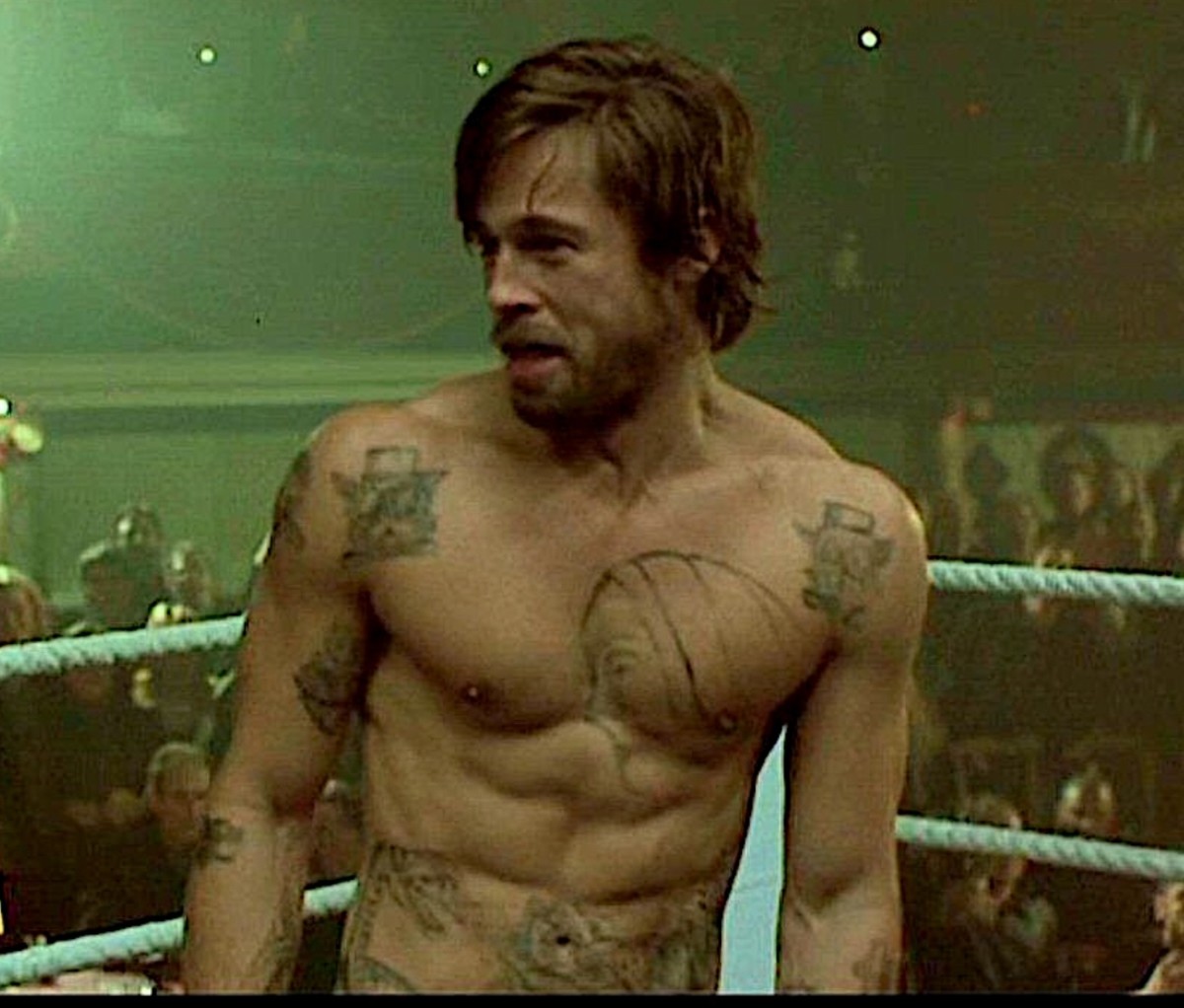
Onscreen as the tattooed Irish brawler, “One Punch” Mickey O’Neil, Pitt was still the epitome of lean but he gained more mass, specifically on his arms and shoulders. Between the two projects, he put on somewhere between five to 10 pounds of muscle, a fair amount given his frame. The feat was accomplished with help from legendary boxing coach Joe Goossen, who has trained pro fighters for decades out of the storied Ten Goose Boxing gym in Los Angeles.
“The fact is, when you spend a lot of your day hitting heavy objects, you’re going to get pumped,” says Goossen. “For those scenes in the movie, he didn’t want to just look strong, he wanted to be strong.”
Goossen gave us a peek into the five-week bootcamp he prepared for Pitt to play “One Punch” Mickey, as well as some insight into his training.
It started with actor Peter Dante. Peter knew Brad, who mentioned he was going to be doing Snatch and Fight Club, and brought up needing a boxing trainer. Peter recommended our gym, which I’ve been at since 1990, and that’s how he ended up there.
What were his training goals?
The first thing we did was have a discussion about the film and his role. The character he was playing was supposed to be a one-punch knockout artist—a brawler with ungodly power in his right hand. One of the goals was to give him a right hand that looked really good—the kind that put you on the ground—and of course a strong jab to complement it. To make his right hand look good, he had to have his shoulders, hips, hands, and everything else in the right position. The secret was to give him all the tools and teach him the fundamentals. You need to have balance and finesse. You only get that by working the left hand and everything else as well. It was a well-rounded program. I wanted to make him a complete fighter.
I treated him like any person who walks in my door wanting to become a boxer. I asked him if he’d ever done sports or boxed in high school, and I was shocked when he said he hadn’t. The way he’s put together, he looks like someone who’s been on a playing field or in a ring before. Brad showed up to work every day of those five weeks. The sessions were at least two hours every time. I always say, don’t estimate what some of these actors do. He put himself through the grinder to get where he ended up. I really put him through his paces.
How did the boxing instruction begin?
I didn’t have him throw any punches the first few days. And before we even got into jump rope or shadow boxing, I wanted to make sure he had the stance down right. I had him move back and forth, with his feet facing the right position, on the balls of his feet, with the heels up. The idea of footwork was probably the most challenging element of his training. But it only took about one week for him to start going in the right direction. I’ve worked with a lot of young amateurs who are coming up to become professional-level fighters. They come into the gym willing to work, but maybe have a few bad habits. I trained Brad in the same way I would train those amateur fighters, minus the heavy sparring of course.
There’s nothing like getting to punch something with the heft of a man and really getting to gas out fully.
How did you get him started with throwing punches?
First we started with the most fundamental of punches, the jab—keeping up those motions but adding the left jab into the process, then you uncork the right hand. This all has to be done to a straight point right in front of you. Once we got the basics out of the way, we started following up with hooks. Even though the script didn’t call for him to have a hook, I wanted to give him a full sense of his capabilities.
Following the first week of footwork and hand placement, I got him involved with the speed bag, which he got the hang of very quickly. We would follow that with the double-ended bag, to help with his timing. By the third week we were working the heavy bag, throwing his punches at the hanging 150 pounds. There’s nothing like getting to punch something with the heft of a man and really getting to gas out fully.
When did you have him step into the ring?
I brought him into the ring around the second week, and we started there by working with the focus mitts. I had him circling me doing jabs, hooks, and body shots. That’s when I could really test his speed and agility, while giving him some guidance on positioning. Later I threw the body cushion on and got him throwing punches at me. I’m used to taking some heavy punches from my fighters, so I wasn’t phased too much, but he could really swing. By the end he had some real force behind those hooks.
Did you have him shadowbox?
That was our finisher for most training days. The gym I work out of is filled with mirrors, so I was able to get a good look at his form and he was able to see how his own movements looked. The key to a great punch is torque. I had to see it, and I could only do that when he was unleashing. So once we got the form right, I let him go all-out—in shadowboxing and on the bags.
What was it like doing those training days with him, beyond the fitness?
Brad was just a fun person to be around, no questions about it, and we enjoyed the time. He got to know all the guys at the gym. When he found out we loved Krispy Kreme donuts, the next day he brought a few boxes for everyone.
How did you feel about how the boxing looked onscreen?
You don’t get a true sense of where he was as a boxer in the movie because it’s peppered into various scenes. There was just a taste of his abilities. But it does show up onscreen in moments and glimpses—the feeling that he’s been in the ring before. The work we put in is not easily forgotten. Brad was in his mid-30s, with his full-man strength, and he was definitely showing it.
Brad Pitt as bare-knuckle boxer Mickey, in a boxing ring, in ‘Snatch’ Sony Pictures Home Entertainment
Train Like Brad Pitt: The Snatch Boxing Workout
Instructions: Perform the drills below in standard boxing rounds: work for 3 minutes, rest for 1 minute. Start with 3 rounds per move, then build up to 5. The best way to become well-versed in these drills is to find a good boxing or MMA gym in your area, but you can also do these drills on your own with a partner.
Assume a fighting stance and start off by focusing on footwork, going forward, backward, left, and right, with your guard up and eyes looking through your eyebrows, locked on your target. Begin to work in the jab during your four-way movement, pushing off your opposite foot to power the punch. Following that round, include short-range hooks and uppercuts. Go back and forth between attacking and moving defensively, never staying still for more than 3 seconds.
1. Jump Rope
Why it works: Jumping rope improves your foot coordination and strengthens the muscles surrounding your feet and ankles, preventing injuries.
How to do it: Hold both ends of the rope at hip level. Rotate your wrists to swing the rope, without moving your arms too much. When the rope comes around, jump with both feet at the same time. Be sure to stay on the balls of your feet, landing softly. Keep your abs engaged and shoulders loose. Repeat until the set is complete.
Why it works: Speed bags teach a fighter to keep their hands up and shift weight between feet when punching. The small surface area improves hand-eye coordination, too.
How to do it: Stand square in front of the bag, a little closer than arm’s length, with both feet equal distance from it. Eyes should be level with the bottom of the bag. Start by hitting the bag with a loose hand, on the fingers, to get used to the rhythm. Your hands should be moving in a small circle, going right-right-left-left, which is the easiest pattern for beginners.
3. Double-End Bag
Why it works: The rapid movements of a double-end bag—a small, circular bag fixed to anchor points on top and bottom by elastic cords—forces boxers to increase their reaction time and speed up punches. This reinforces the importance of head movement, promotes the use of angles and footwork, and encourages high-volume punching.
How to do it: Starting in the fighting position, hit the bag with constant combinations to keep it moving, without letting the bag slow down. Transition between throwing combinations, then going on the defense, letting the bag bounce off your guard, then starting on the attack again. The basic rhythm for beginners is left-left-right and right-right-left, using jabs and crosses.
4. Focus Mitts
Why it works: Focus mitts bridge the gap between bag work and sparring. They’re used as an augment to sparring, as well as develop good punch combinations and defensive maneuvers such as slipping, bobbing, and weaving.
How to do it: Getting an experience trainer in the mitts is always helpful, but not necessary. You can also put them on the hands of a training partner to start. Be sure to work out the punching patterns with your training partner, kicking off with basic combos; at the beginning, focus just on the jab. Keep hitting the pads with the jab, increasing the speed and power to get a feel for how a true punch feels on the mitts. Start to add the right or left cross to your jab, then finish with a hook, leading up to the jab-cross-hook combo.
Why it works: The heavy bag is a vital piece of gear. It’s an incredible target for a boxer to practice and perfect jabs, power punches, hooks, angle punches, and combinations, in addition to increasing power, speed, footwork, and movement.
How to do it: The punches on a heavy bag are not all about power, they’re also about speed and snap. Don’t push the bag with your punches. Instead, focus on your form all the way to contact, then snap your hand back, keeping the bag moving as little as possible. Once you get comfortable throwing combinations properly at the bag, practice good footwork by moving around it, circling left and right, while in the flow.
6. Body Cushion
Why it works: The body cushions, or protectors, are designed to allow the boxer to practice their body punch combinations during pad workouts. They’re usually combined with focus mitts. They offer a more realistic workout because the boxer is able to throw a variety of punches.
How to do it: Like focus mitts, it’s good to get some sessions with an experienced boxing coach wearing the body cushion, but it can also be practiced with your training partner. Put all of the learned skills at play during this drill, throwing the previous combinations at the focus mitts but adding jabs to the body. Once you hit them with a combination—or a jab, slip to the left or right—follow with another attack. Practice your defense by having your training partner feint a punch with their mitts and blocking it with your guard.
Why it works: When done properly, and with the right goals in mind, shadow boxing can improve your boxing technique, strength, power, speed, endurance, rhythm, footwork, offense and defense, and overall fighting abilities.
How to do it: Stay light on your feet and throw punches at the air. Do basic jab, cross, and hook combos.
For those not “in the know” on the energy waffle, don’t be bummed. The phenomenon actually started centuries ago in the Netherlands, when bakers in the Dutch town of Gouda began making what they called Stroopwafels—literal translation “syrup waffle”—a hand-pressed treat concocted of sweet syrup made from beet sugar and thin, crisp wafers.
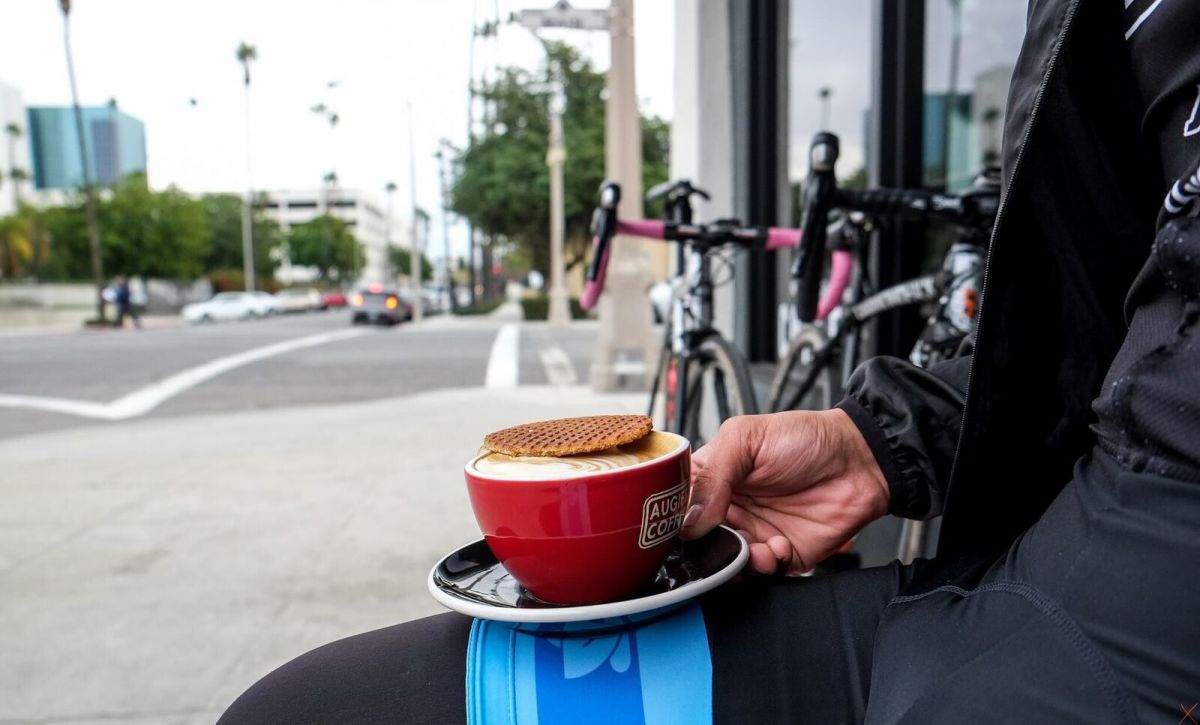
Heated over a cup of coffee or tea, the energy waffle is a warm, gooey energy source. Photo: Rip Van Wafels
But the small-yet-filling (and interestingly satisfying) treat has only really risen in US markets in recent years, particularly with the active outdoor crowd. Companies like Honey Stinger, GU Energy Labs and Rip Van Wafels, have unleashed the on-the-go snack to the masses; they can even be found in the energy bar section of REI and other stores that cater to outdoor and active lifestyles.
The history of the stroopwafel being used for energy dates back to their adoption by the Belgium bicycling community. Cyclists turned to the stroopwafel, looking for an easy-to-pack, energy-revving option that could be tucked away in a jersey.
While it may seem arbitrary, this tradition is one that’s widely recognized in the region.
“The Dutch are avid cyclists so it makes sense that they picked up on the stroopwafel’s high-carb-to-sugar ratio becoming the perfect fuel-up before or during rides,” says Netherlands native and Rip Van Wafels Co-founder Rip Pruisken. “It can also get to be quite cold in the Netherlands so prior to your ride the traditional way of eating the waffle—warming it on top of a coffee or tea—is also the perfect pre-ride ritual.”
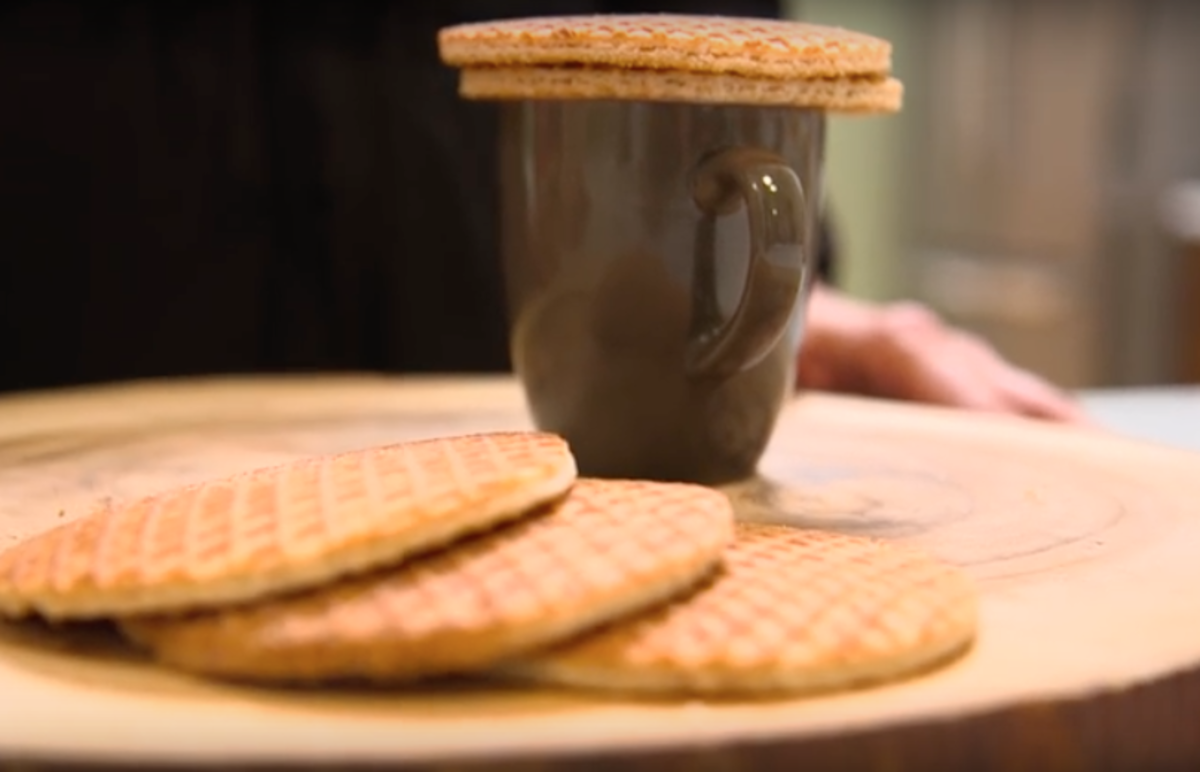
Whether dunked or just lightly steamed over your morning beverage, the stroopwafel is touted to provide sustainable energy. Photo: GU Energy Labs
These days, companies competing in the space have subbed out syrups for slightly different, more health-conscious ingredients like honey and tapioca syrup, supporting a sustainable energy release over long periods of time.
What would these companies say to people who think the stroopwafel is just a glorified cookie?
“We’ve got a crazy loyal following of active outdoor athletes that eat our waffles in the morning with coffee or tea, during breaks while they bike or on a hike to help keep energy levels up,” says Honey Stinger Co-owner Len Zanni. “A lot of customers report using them as fuel for marathons and ultra running events or long distance cycling rides.”
The stroopwafel is still a novelty to many, and we were curious to put the different variations to the test.
Taste Test
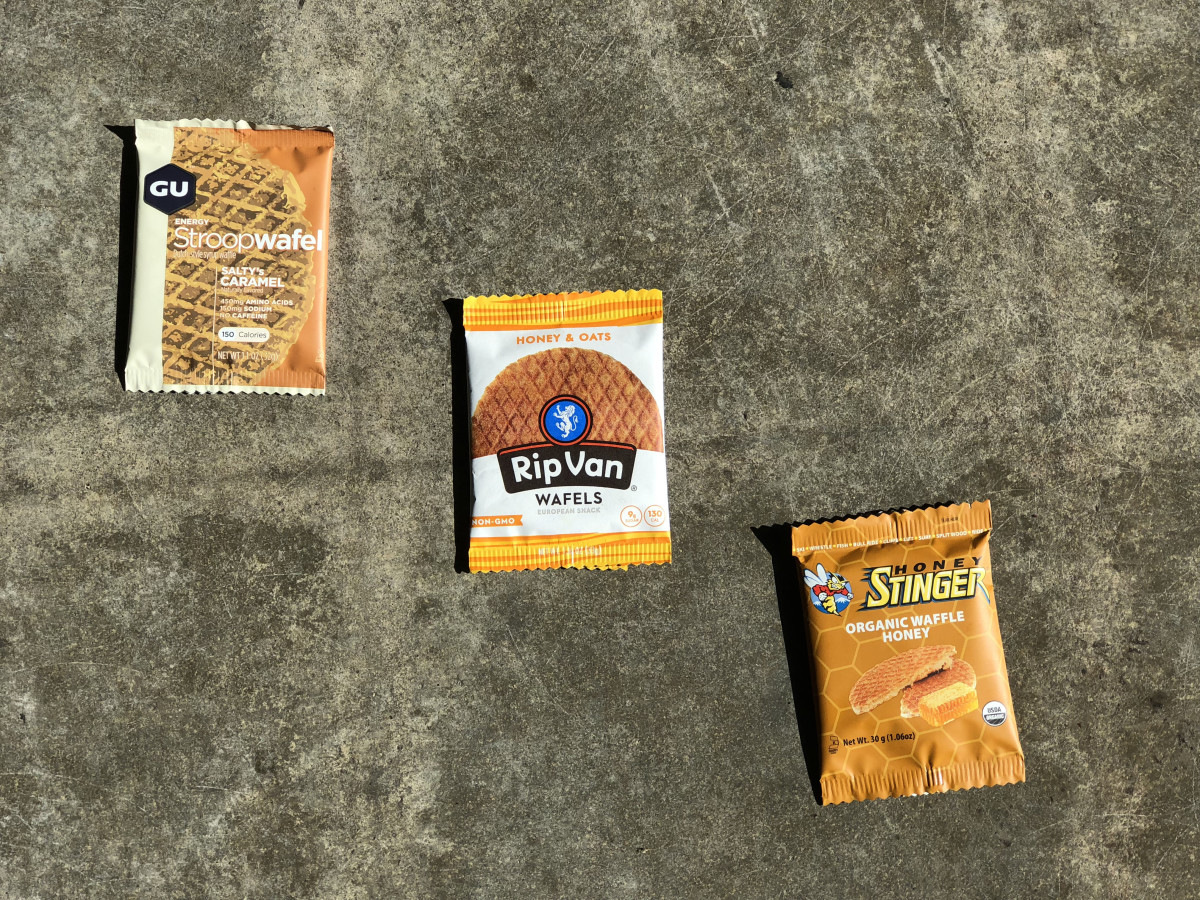
We taste-tested three leading energy waffles. Here’s what happened. Photo: James Rodney
Rip Van Wafels, launched in 2010 at Brown University through a Kickstarter campaign, is now based in San Francisco. Their mantra is to create convenient food options that are healthier.
In addition to Rip’s, we put waffles to the test from Colorado-based Honey Stinger and Berkeley, California GU Energy Labs.
Honey Stinger has been around for decades, but started putting energy waffles on the market in 2010, with help and inspiration from part-owner and well-known cyclist Lance Armstrong.
Everything Honey Stinger does revolves around (you guessed it) honey. Their waffles have a thicker profile than Rip Van Wafels, and appear to contain more filling when you bite into it.
Honey Stinger has also introduced a gluten-free option for those with certain food restrictions. We had a chance to taste those, and the subtle difference in taste is almost indiscernible.
For this comparison, though, we tasted Honey Stinger’s Organic Honey Waffle. Honey Stinger’s outer wafer tasted less sugary compared to Rip Van Wafels’, while the inner filling had a subtle sweetness to offset this.
Rip Van Wafels’ filling was a thinner layer than Honey Stinger’s, but was more chewy and gooey in consistency.
The GU Stroopwafel had the least chewy consistency of all the fillings, and the outer wafer also seemed to contain a bit more oil to the touch. Though it may just have been indicative of the two flavors we tried—Salty Caramel and Salted Chocolate—GU’s wafels tasted a bit more sodium-heavy than others.
From a pure taste perspective, Honey Stinger and GU tasted more like something we’d bring on the trail, while Rip Van Wafels were equally as delicious, but really tasted more like a treat we wouldn’t feel as bad indulging in.
Our favorite flavor from Rip was a tie between the Chocolate Brownie and the Dutch Caramel and Vanilla. We weren’t a big fan of the Toasted Coconut.
Nutrition Comparison
Biking and stroopwafels are a perfect marriage for many in the cycling community. Photo: Rip Van Wafels
When discussing energy, it’s common sense to take a look at some of the basic sources, like carbs, sugar, and protein.
Honey Stinger’s waffles contain about 11 grams of sugar and 21 grams of carbs in a serving, which is one, 1-ounce waffle. You are getting 150 calories in a serving, which could power a quick run or longer hike or bike ride.
GU contains 140 calories, and similarly has 10 grams of sugar and 21 grams of carbs.
Rip Van Wafels hover around 8 to 9 grams of sugar depending on the flavor, and contain 18-20 grams of carbs and 130 calories.
Rip Van Wafels also have roughly 8 to 9 grams of “added sugars” in addition to the sugar listed above.
Another thing that stuck out to us about Rip Van Wafels is that one of our favorite flavors, the Chocolate Brownie, contained 155 mg of sodium.
Curious if that was the norm, we took a look at the others, and realized that other Rip Van Wafels flavors and the Organic Honey Waffle from Honey Stingers only contained roughly 55-60 mg of sodium. The two flavors from GU, however, did also contained 150 mg of sodium.
A burst of energy is needed to power through that late afternoon run. Photo: Honey Stinger
Fat content didn’t fluctuate too much between the different waffles—Honey Stinger with 7 grams, GU with 6 grams, and Rip Van Wafels with 6 grams.
While all of the waffles for this test contain wheat, eggs, and milk, there were ingredient variations to note. Rip Van Wafels’ ingredients are non-GMO verified, and contain chickpea flour and organic tapioca syrup.
Honey Stinger and GU both use organic wheat flour as its main ingredients. Honey Stinger also contains organic rice syrup.
Honey Stinger and GU contain soy flour, something for those with allergies to note.
All three waffle companies use palm oil and cane sugar.
Each contain about 1 gram of protein per serving, and while GU and Honey Stinger are not significant sources of calcium, Rip Van Wafels contains about 2 percent of daily value in one serving.
GU’s flavors contain an amino acid blend of L-Leucine, L-Valine and L-Isoleucine, which set them apart from the others. Upon further research, this combination could help prevent muscle breakdown during active pursuits.
Conclusion
We found each of these waffles really did sustain hunger cravings and energy throughout the day for moderate activity levels, especially if eaten around breakfast with a cup of coffee.
After a few hours, energy levels dip and you need to replenish, especially if taking part in high-intensity activities.
The ease of packaging really does allow for quick snacking just about anywhere, anytime, which helped make us a fan of the energy waffle. Not to mention, they really are indescribably tasty.
Taking both taste and nutrition into consideration, the following would be our recommendations:
Best Overall Flavor: Honey Stinger
Best Chewy, Gooey Consistency: Rip Van Wafel
Best for Sustainable Energy: GU or Honey Stinger
Best Indulgent Treat: Rip Van Wafel’s Chocolate Brownie
You know the saying: Old habits die hard. For musician and filmmaker Michael Franti, those habits finally caught up with him in March 2019 when he stepped on the scale and saw 240 pounds. But he had some serious doubts about overcoming them. After all, he’d been living this way for decades—touring on the road, working 18-hour days, sleeping four hours a night (if he was lucky), and using sugar as a crutch to boost waning energy levels.
Unsurprisingly, he felt exhausted most days. Other than practicing yoga a couple times a week, he says the only other exercise he got was trying to burn as many calories as possible running around on stage every night. After most shows, he’d usually eat half a pizza and wash it down with margaritas before crashing in the tour bus bed.
And while this way of life is de rigueur for most touring artists, Franti thought, Man, I gotta do something different. So he vowed to make some changes.
“The only problem was that at 53, I had two knee surgeries [on the same knee from overuse injuries], and could no longer bounce back the way I did at age 23, 33, or 43 for that matter,” he says. What’s more, he had just welcomed an energetic baby boy into the family who wasn’t exactly going to wait around for him to sleep in.
Something’s Gotta Give
All in all, Franti didn’t realize how “unwell” he really was.
“I just assumed feeling shitty a lot of the time and the extra middle I’d put around my gut was part of being over 50,” he says.
And even though Franti was a former recreational runner and collegiate basketball player, he wasn’t sure where to begin. But as fate would have it, that summer, Christina Farias, a fan who also happened to be a wellness coach reached out on social media offering to help him get back in shape.
“She told me it would take six weeks to create new habits, six months to make them feel effortless, and, after a year of creating new habits, they would stay with me for life,” he explains. “I didn’t believe her. Or, it wasn’t so much that I didn’t believe her, I didn’t believe I had the ability to do it.”
But that June, Franti committed—if he felt better after working with Farias after six weeks, he’d continue on in hopes of meeting his goal of losing 25 pounds and gaining some muscle.
“Farias told me that wellness wasn’t about dropping 10 pounds—even though that might be a goal—but, rather, it was about creating great habits,” he says.
Creating New Habits
First, they evaluated Franti’s diet. His impulse to grab anything with sugar in it—licorice, chocolate, ice cream, cake, cookies; you name it—was first to go. Next he cleared out any other junk food and went on a high-protein, plant-based meal plan.
“I created a food calendar and started doing weekly meal prep to have on the tour bus,” he says.
What’s more, he swapped juice, soda, and kombucha for plain ol’ water, aiming to drink 3-5 liters per day.
The only calories he drank came from smoothies made with plant-based protein powder, blueberries, oats, peanut butter, water, and ice. “These were more like a complete meal, so by the time I was done, I was full,” says Franti. “I had to make sure I was eating on a schedule [roughly four meals a day] so I never felt hungry.”
Next on the list was his activity. Gone were the days of calling sporadic yoga and on-stage performance a “workout routine.” Franti started training five days a week focusing mostly on HIIT training and keeping things interesting with dumbbells, resistance bands, medicine balls, a Bosu ball, and even a Pilates ring. He also continued to practice yoga a few times a week and began using an activity tracker to keep an eye on his daily steps, which was a “game changer,” he says because he wasn’t walking much before. “I’d go from the tour bus to a car and that was it,” he says.
But since incorporating the tracker, “even on days when I didn’t work out, I made sure I got my steps in,” says Franti. “Before I knew it, the strength and mobility were coming back to life in my knee, and low back issues that plagued me for years were going away.” Soon he was able to run again.
While cutting out sugar and sticking to HIIT were difficult to stick to, neither were as tough as improving his sleep hygiene. “Sleeping was the greatest challenge for me,” he says. “I worry a lot, and part of it has to do with not being able to shut my brain down at night.” The biggest culprit was another vice: booze.
“Alcohol put me to sleep at first, but then about two hours later, I’d wake up and couldn’t go back to sleep,” he explains. So, first Franti cut back his drinking to two drinks a week, then one, then none—no small feat.
In addition, he made sure to turn all screens off an hour before bed (since the blue light emitted from tech has been shown to mess with your sleep-inducing hormones) but also “all the stuff I was reading from emails and the news and Instagram was stressing me out and kept my wheels spinning all night,” he explains.
These efforts led Franti to sleep more incrementally over time: What began as three to four hours a night turned into five, then he tried adding another 15 minutes and so on until he was successfully sleeping six and a half hours most nights.
Each week he checked in with Farias to report back on what worked, what didn’t, where he fell short, and what he could improve on in the coming days. But the results spoke for themselves: Franti was sleeping more, drinking less, gaining strength, and six months into his journey he lost 25 pounds. “But by that point something much more important happened,” he says. “I felt better.”
Over the course of his work with Farias and the dedication he found within himself, he realized that losing weight (and that initial number he saw on the scale) was really just skimming the surface of what this lifestyle transformation was really all about.
Now, Franti says “I’m less tired, less stressed, and lighter on my feet. I can walk effortlessly for miles. I’m able to run every day again. I play basketball five days a week. I’m stronger physically in every way. I’m more rested, and I sing better because of it. My eyes are clearer, and I look fitter, but most importantly, I’m happier.”
A New Outlook on Life
Franti says the methods he’s learned to replace bad habits is something he plans to apply to other areas of his life, too. “As a father, it’s easier for me to pick up my baby,” he adds. “My wife and I bonded a lot over the training, food preparation, and eating better together.”
Plus, he says his entire perspective on wellness has changed. “It’s not just about having an organic salad every now and then between eating like shit,” he says, “and it’s not about having a really mindful yoga class two days a week and never sleeping.” Wellness is about feeling great, knowing each day you’ve done something good for yourself and are more equipped to handle life’s stressors—feeling healthier and happier, he adds.
Since then, Franti has gone on to lose another six pounds and has even begun hosting yoga retreats at his property, Soulshine Bali, a boutique hotel, which is where you’ll find him, his wife, and Taj, now 20 months old, hunkering down during the coronavirus quarantine. While you can’t catch Franti in down dog any time soon, you can check out his latest album, Work Hard and Be Nice, debuting on June 19.
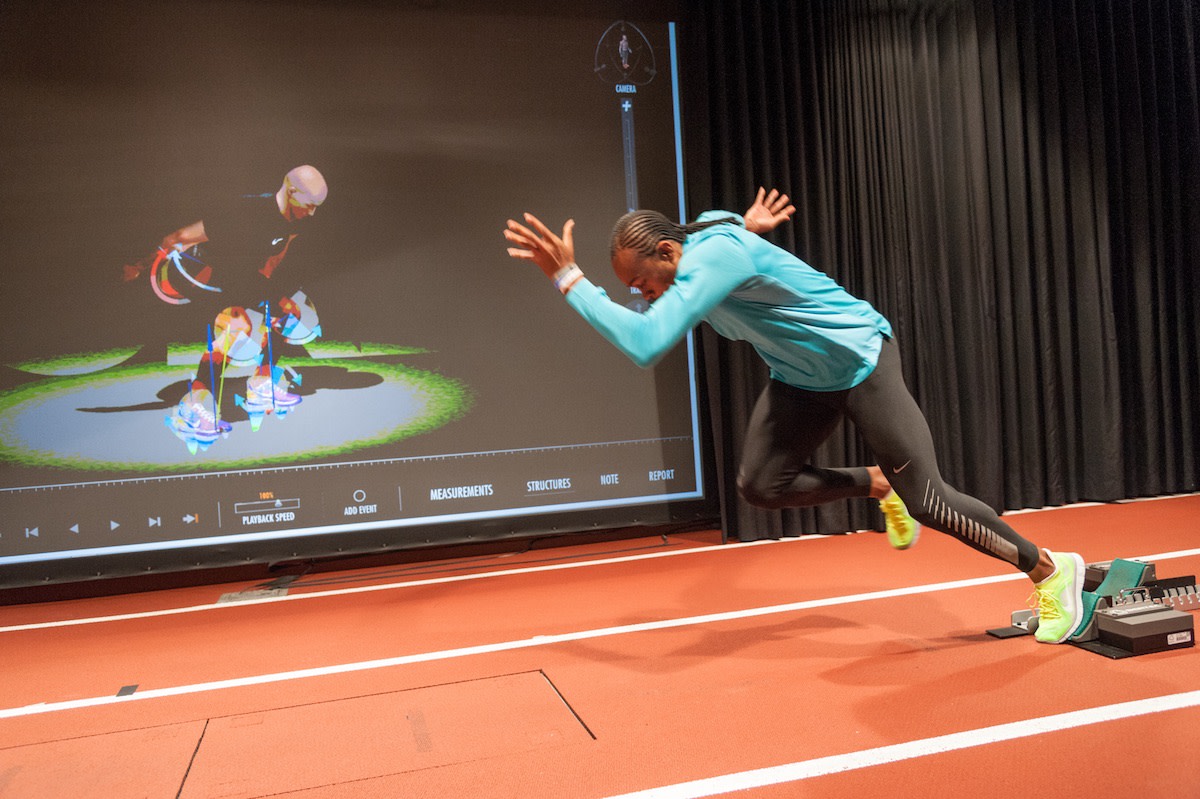
“Most people remember Breaking2 as a spectacle. Three runners, pacers, big crowds, and a race track in Italy, trying to break one of the last great thresholds in sport. But it started years earlier, humbly, on a whiteboard,” says Brett Kirby, a Human Performance Researcher at the Nike Science Research Lab (NSRL) who quarterbacked the project.
Kirby, a self-described academic, holds a Ph.D. in Biomedical Sciences and taught at both Duke and University of Oregon, before his current tenure at Nike. He studies the physiology of the world’s best athletes–how cardio, neurological, and muscular systems work together. “It’s a blend of art and science,” he explains. “A holistic view of athletes, helping them progress to the best of their ability.”
Photo: Courtesy of NIKE
The NSRL is a team of 60 from widely diverse backgrounds: bio-mechanical researchers, computer scientists, behavioral experts, and data scientists. They work on a variety of projects, from the FuelBand and Nike Training Club app, to human endurance feats like Breaking2. The lab, says Kirby, aims to ignite imaginations. “We want people to question their perceived barriers, like how fast they can run,” he says.
Many of the top professional runners in the world opted out of Breaking2 due to concerns about new training strategies. “It’s always a risk to change your training, but all three bought in right away,” says Kirby. “We had to juggle opposing forces—trying new strategies versus staying consistent over a long time. We needed to be mindful about how we did that. We made modifications really slowly.”
As the behind-the-scenes liaison between Nike and the athletes, Kirby built the architecture of the project, balancing training regimens and course logistics with the grand show of the event. In the end, he was proud of how it worked out. “I was surprised at how close they came to the two-hour barrier and surprised at the appetite from the world,” he explains. “The only thing I wish we changed is to give others this kind of opportunity.”
If you’re looking to break running barriers, Kirby offered these lessons that every runner can employ.
Shoe Fit
“It’s quite important for a couple reasons, but maybe not what most would expect. Of course a good fit will reduce injuries and blisters, butt perceived fit is a hygge deal. Psychological fit is real. Runners that feel more secure and confident will run faster.”
Photo: Courtesy of NIKE
Hot and Cold Therapy
“This domain is starting to shift with some recently published literature. Historical information always leaned on ice baths but some new studies show that regular ice baths can actually decrease adaptation and slow your progression. There’s increasing evidence that heat during warm up and post exercise is more impactful.”
“There’s a strong consensus that the most important thing you can do is intake protein and carbs after exercise, especially if you went hard. This is true, but debating the exact amount of grams sometimes misses the point.
“The most important part is the timing. It needs to be right away. We learned this with our runners who are from different cultures and eat different foods. We focused much more on timing than the exact things they ate and it worked well.”
Photo: Courtesy of NIKE
Load Management
“It’s truly different for everybody. What I will say is that you need to be consistently slow with introducing new things. It’s important to dream big but take your time to get there. This is true for the rate at which you take on and off the load.
“Often, the athletes knew better than we did when they needed an off day to let the body recover and we would always listen to that.”
Photo: Courtesy of NIKE
Cross Training
“We’ve seen some positive effects of crossing training, especially when it’s targeted. It can help build strength in areas not activated during running.
“For example, some biking or core exercises can work ‘sleepy’ muscles that aren’t often challenged during a workout run but later in a race we fall back on these muscles and they need to have supportive strength.”
“As much as you can. It’s the single best way to recover and get stronger. Probably can’t emphasize this enough.”
Photo: Courtesy of NIKE
Massage
“There is growing data on the benefits of massage and percussive therapy, but the most important thing is what an athlete feels is right for their body. What they like and what they perceive helps them.
“We have plenty of athletes that are against a lot of the literature and are still great. We’ve learned to balance what they care about with the fine print from all this research.”
Photo: Courtesy of NIKE
Stress
“There’s so much extra stress during COVID-19 and the trade-offs are big right now. It’s always a trade-off to make time for a workout and sometimes it’s better if you keep moving forward.
“If you miss a workout, don’t stress it. That can be more harmful than good.”